


Have you ever spent weeks creating the perfect campaign, only to see it not move the needle at all? Maybe the clicks came in, but the conversions didn’t follow. Or your leads sounded great on paper, but never actually became customers. It’s frustrating right?. It just makes you wonder what is missing. Something might surprise you here. What if the issue isn’t your message or your product, but the fact that you’re not considering company size?
We assume it’s easy to treat all businesses the same way. A five person startup and a company with thousand employees operate differently in their thinking, purchasing, and decision-making. If your marketing is speaking to everyone the same way it tends to be speaking to no one at all.
Quietly, this simple oversight can drain your results. The costs of acquiring customers increase. Engagement drops. Campaigns fail to hit the mark. However, once companies segmented by size, the difference is clear. This results in better fit leads, higher conversion rates and bigger deals. The fact is, marketers who personalize based on company size have reported up to a 1.5 times increase in average deal size. According to some, if you become more relevant in your outreach, your conversion rates can jump as much as 50 percent.
That’s kind of a shift worth paying attention to. This way of thinking opens up a whole new possibility in strategy and makes you wonder what else is possible.In this blog, we are going to take a look at why company size matters more than you might think, how it influences buying behavior and what you can do to adjust your marketing in order to achieve better results.
Table of Contents
1. How Ignoring Company Size Bleeds Your Budget
Having seen now why company size deserves more attention, let’s have a closer look at what’s actually happening when we ignore it. When you try to talk to every business the same way you’re casting a wide net. You might think you are reaching more people, but in turn, you are just attracting the wrong ones. Your ads and your content are missing the mark. You’re getting leads, but they’re not turning into conversions. This results in your sales team spending valuable time chasing prospects that never fit. And all of this makes getting the right customers much more expensive.
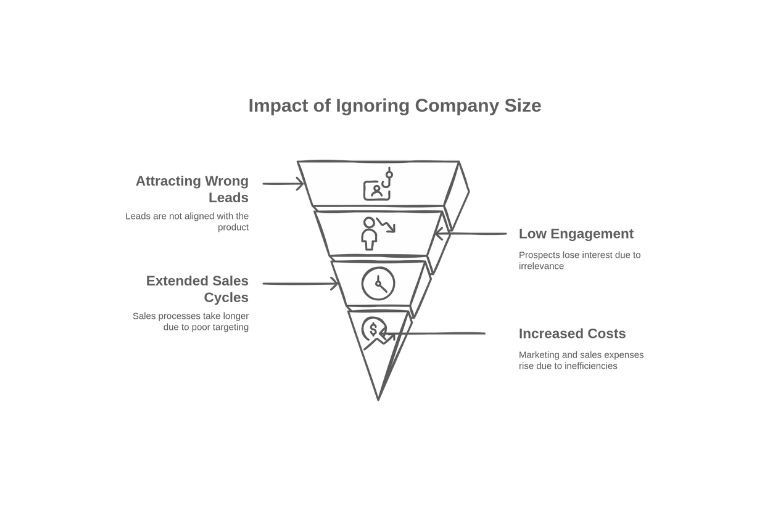
Your offer can also feel out of place without considering company size. Complex features or pricing too high could overwhelm small businesses. While smaller companies might be ok with a simpler solution, larger companies would be in need of more advanced ones and lose interest fast if your product is too basic. The result is the same either way. They move on. As a result, there is low engagement. People tune out when they don’t see themselves in the messaging. And even if they do sign up, they’re most likely to quit early.
Every day, sales teams feel the impact. If leads are not qualified, everything comes to a halt. It wastes time, energy and results. In fact, research has shown that sales cycles can extend by twenty to thirty percent with bad targeting. Nearly 42% of sales reps agree that unqualified leads and bad data are some of their biggest challenges.
But all of this leads to one very clear takeaway. Ignoring company size doesn’t just weaken your message; it adds real costs across marketing and sales.
2. How Company Size Shapes Buying Behavior
Once you start seeing just how much budget gets wasted when company size is ignored, the next natural question is why this is happening in the first place. Why do small and large businesses respond so differently?
The answer lies in how they decide, what they care about and how they do it. Smaller businesses tend to be fast. They have less decision makers, they are more focused on quick results. What they want is tools that are easy to set up, easy to use and produce value immediately. They pay attention to something that saves them time or money without adding complexity.
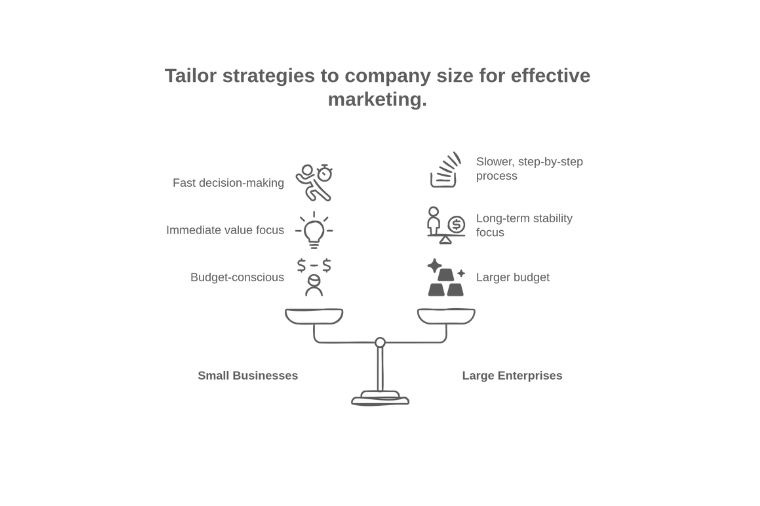
Things are done differently in larger companies. They have a slower, more step by step buying process. There are multiple departments involved and most of the time the priorities are on scalability, security and long term stability. Even if your product does fit their needs, it must pass through more hands before they buy.
Behavior is also shaped by budget constraints. Pricing might be a hesitation for a startup and they might be looking for immediate returns. An enterprise might have a larger budget, but every purchase must support the organization’s larger goals and adhere to formal procurement procedures. These differences stretch to pain points as well. Such as a startup founder may be worried about traction and moving fast.
Whereas a Fortune 500 executive is focused on consistency, compliance and large scale efficiency. They are tackling completely very different problems. That is exactly why a single message cannot speak to both. Motivations and decision making processes are just not the same.
A great example is Zoom. It began with helping smaller businesses with a simple video solution that just worked. It wasn’t designed to be a large enterprise platform. It solved one group’s pain point exceptionally well which gave it momentum and scaled later with confidence.
This all demonstrates that knowing how company size impacts buying behavior is not only advantageous but essential. If you align your approach with how different businesses think and decide, your message resonates more and results follow.
3. The ROI Multiplier
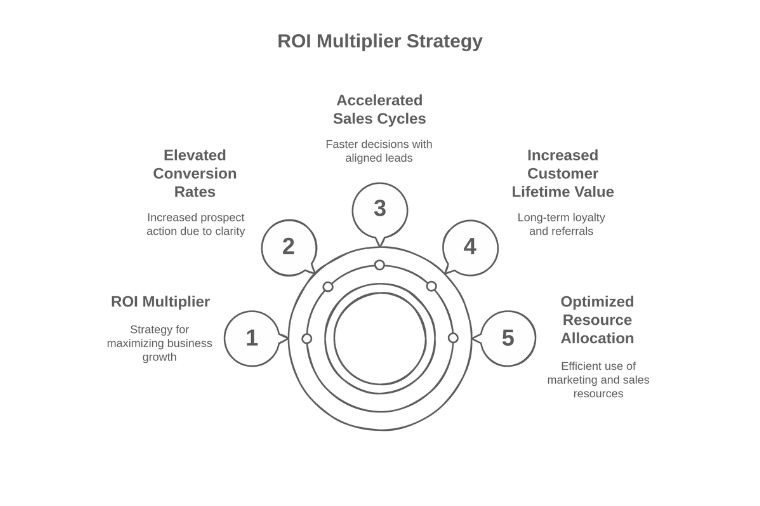
Now, with all we have covered so far, it is obvious that treating all businesses the same will hinder your growth. As your strategy begins to align with company size, the results become immediate and powerful.
1. Elevated Conversion Rates:
If your message is aimed at a certain type of business, it will seem more relevant. Small companies engage more if they see that you understand their day to day challenges. The larger businesses will respond when you show them how you can scale with them and solve deeper problems. The higher the clarity, the greater the chances a prospect will act.
2. Accelerated Sales Cycles:
Your sales process moves faster as your leads get better aligned. You don’t spend your time anymore trying to convert companies that were never a good fit. What you are doing instead is focusing on prospects that are more likely to buy. The result is faster, more confident decisions and better use of time.
3. Increased Customer Lifetime Value (LTV):
There is a long term benefit as well. If you attract customers that really fit what you offer, they tend to stick around longer and grow with you. They are more likely to be satisfied, loyal and even refer others. This, in turn, naturally increases your customer lifetime value and creates steady momentum.
4. Optimized Resource Allocation:
Another benefit of this focus is how clear it makes your resource usage. Your campaigns are targeted only at the right audiences and this means that your marketing budgets go further. Sales teams don’t waste their time on leads that aren’t a good fit. It’s easier and everything is more focused and more efficient.
This is evident in how successful companies grow. For example, Mailchimp got early traction by building features and pricing designed just for small businesses. It didn’t attempt to serve everybody at once. One segment they chose and did exceptionally well in which led to long term success.
4. Implement Company Size Segmentation
Why is segmentation by company size so important? Because without it, marketing and sales end up spending resources and time with messages that are not in tune. Knowing how to segment by company size will allow you to tailor your approach and therefore make each of these interactions more relevant and successful.
1. Leveraging Firmographic Data
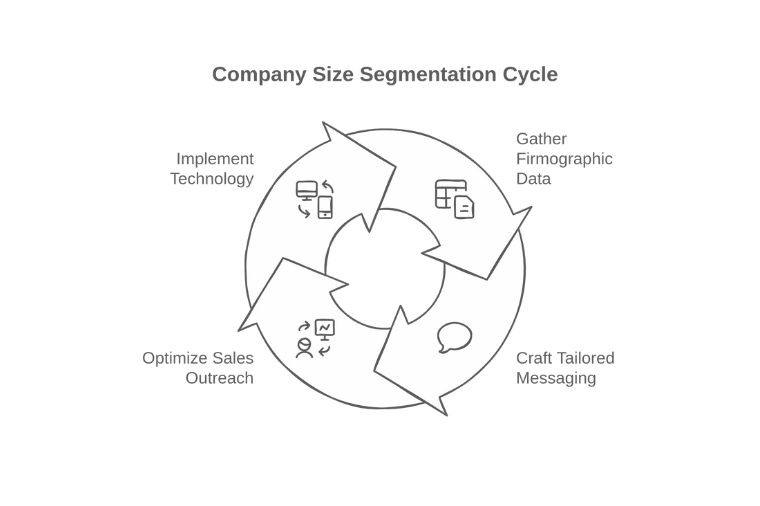
To do this well, you need to use firmographic data, like employee count, annual revenue, industry and location. These details allow you to group companies properly, instead of just guessing.
2. Crafting Tailored Messaging & Content
Then develop messaging that speaks to the needs of each group. Small to medium businesses are often after affordable, easy-to-use solutions with quick results. Larger enterprises are more concerned about security, scalability, integration, and long-term partnerships. By aligning your content to those priorities, you show that you are well aware of what matters to each audience.
3. Optimizing Sales Outreach
Modify sales outreach according to company size. A smaller business will do well with direct, blunt communications. Whereas, an enterprise will require more of a consultative approach involving numerous stakeholders. Knowing the above will ultimately help your sales team connect better and close deals faster.
4. Tools & Technologies:
Technology backs the process. Tools like CRM systems, conversion rate optimization tools (CRO), as well as data enrichment services, keep your data well organized and help you create personalized campaigns at scale. These technologies make segmentation practical and efficient.
Salesforce is a great example. From tools for small businesses to enterprises in the cloud, their products are designed with the knowledge of different company sizes and the understanding of their respective needs, resulting in continued growth.
5. Conversion Optimization Tools for Smart Segmentation

Following on from what we’ve seen about company size segmentation, this is where conversion rate optimization tools can really help solve the puzzle. Picture these tools silently collecting additional information about your leads such as the size of their company and which industry they’re in without you having to do a thing. Once you have this rich information, they automatically group your prospects into clear segments.
Next, the magic continues by your website adapting in real time to display personalized messages and calls to action that speak directly to the needs of each individual visitor. Advanced AI behind the scenes makes sure your advertising budget is spent only on the most promising prospects. On top of all of that, these tools continue to test different approaches until they find out what actually works with each segment.
This results in smarter, sharper marketing that cuts waste and delivers better results with far less guesswork.
Conclusion
Not taking company size into account when building out marketing and sales strategies can be very costly, resulting in inflated acquisition costs, low engagement and wasted resources. The cost of a one size fits all approach is obvious and businesses need to rethink how they reach and engage with audiences.
Strategic segmentation based on company size enables measurable outcomes such as higher conversion rates, shorter sales cycles, and better customer lifetime value. Unlocking such advantages would require auditing current campaigns, looking into external data enrichment tools, and conducting A/B tests for refining the segmentation.
Author Bio:

Vidhatanand is the Founder and CTO of Fragmatic, a web personalization platform for B2B businesses. He specializes in advancing AI-driven personalization and is passionate about creating technologies that help businesses deliver meaningful digital experiences.

